Understand fuel quality, performance, and compatibility
“Your CNG engine can’t tell where its methane came from. It only cares about what’s in the tank.”
There is a popular misconception that Compressed Bio Gas or CBG is the same as Gobar gas and therefore an impure source of fuel that can reduce vehicle mileage, damage the engine or cause other problems. However, most of these myths stem from not understanding how CBG is produced, the different ways in which it can be produced and what determines the fuel quality. This blog aims to alleviate the popular concerns regarding CBG adoption and explore how CBG can serve as a clean automotive fuel alternative to CNG.
CBG vs CNG: Are They Chemically the Same?
Compressed Natural Gas (CNG), a by-product of petroleum, is primarily composed of 85% to 98% methane with trace amounts of nitrogen, carbon dioxide, and other hydrocarbons such as ethane and butane.
Biogas on the other hand, is a naturally occurring by-product of the anaerobic decomposition of organic biomass. Refer to the previous blog to learn more about its chemical composition and the detrimental environmental effects of untreated biogas. CBG alternatively known as Biological Compressed Natural Gas (Bio-CNG), is obtained by purifying biogas using special technology to remove carbon dioxide, hydrogen sulphide, and other impurities.
The CBG obtained through this process usually contains over 95% methane but the actual methane content in CBG is vastly dependent on the feedstock and purification process used by the biogas plant, discussed further in the blog. Biogas plants such as Sai Bioenergy have been able to achieve over 98% methane in their Bio-CNG.
Both CBG and CNG are compressed methane with the same calorific value and performance. The key difference between both fuel forms is that CNG is a non-renewable source of energy while CBG can be produced from any organic biomass, making it a renewable fuel and a sustainable alternative to CNG.
The question is no longer about CBG vs CNG but whether CBG is an economical green fuel alternative for your vehicle or not.
CBG Is Not Gobar Gas!
Know What Happens Before the Fuel Reaches Your Vehicle
Gobar gas is a type of raw biogas produced through the fermentation of cow dung and other organic waste. It is often used in rural Indian households for cooking, heating, and small-scale electricity generation and helps reduce their dependency on firewood.
Though Gobar gas is also a by-product of organic waste decomposition, the feedstock (biomass) used in its production makes its chemical composition and calorific value vastly different from that of CBG. Compressed Bio Gas or Bio-CNG, unlike Gobar gas, is purified biogas produced only in government approved plants, adhering to strict quality standards to promote usage as a renewable transport fuel.
| Difference Between Raw Biogas (Gobar Gas) and Compressed Biogas (CBG) or Bio-CNG | ||
| Composition | Gobar gas | CBG or BioCNG |
| Methane | 55-65% | >90% |
| Carbon Dioxide | 30-40% | <4% |
| Hydrogen Sulphide | 0.1-4% | <16ppm[1] |
| Nitrogen | 3% | <0.5% |
| Oxygen | 0.1-2% | <0.5% |
| Moisture | 1.2% | 0% |
| Calorific Value | 19.5 MJ/kg | 47-52 MJ/kg |
[1] Parts per million
What Can CBG Be Made From and How Feedstock Affects Fuel Quality
While biogas can be produced from many different kinds of organic waste or biomass (feedstock), not all types of feedstock produce the same quantity and quality of CBG. Feedstock with higher biodegradability produce greater amounts of raw biogas resulting in higher CBG quantities.
Biomass Feedstock Classification
| Urban Waste | Agricultural Waste | Industrial Waste |
| 1. Kitchen, garden and household garbage 2. Cattle dung 3. Fruits and vegetables 4. Poultry waste 5. Commercial and industrial garbage | 1. Paddy straw 2. Green grass 3. Residue and effluents from agro-processing industries | 1. Paper and pulp 2. Milk processing 3. Spent wash from distilleries 4. Oil extraction plants 5. Sugar industry 6. Slaughter house or tanneries 7. Pharmaceutical waste |
The efficiency of converting biomass to Bio-CNG/CBG is vastly dependent on the type of feedstock and technology used. Biogas plants such as Sai Bioenergy use a combination of paddy straw and napier grass to achieve >98% methane quality in their CBG.
Will CBG Affect Your Vehicle’s Engine or Mileage?
CBG and CNG share the same calorific value and therefore are virtually similar fuels. Your existing CNG vehicle is already calibrated to work with CBG.
While purified and Compressed Bio Gas is safe for vehicles, unpurified biogas will cause damage to vehicles. The hydrogen sulphide (H2S) found in biogas is particularly harmful, causing severe corrosion and wear in boilers and engine parts (combustion chamber, exhaust system, bearings). The H2S quantity in biogas depends on the type of feedstock used. Generally, plant material introduces minimal H2S while animal sources and molasses produce larger amounts of H2S.
| Feedstock Type | Biomass-to-BioCNG Conversion Efficiency |
| Agriculture waste-based plants | 10% |
| Sugar press mud or waste sewage treatment plants (STP) sludge | 5% |
| Vegetable based waste | 4% |
Before biogas can be utilized as a fuel, it is essential to eliminate sulphur compounds from the gas and purify it. Compression alone is not sufficient to convert raw biogas into a biofuel that is equivalent in quality and performance as CNG.
Biogas plants in India use different purification processes to achieve their high methane content. Sai Bioenergy utilizes a captive technology called Sulfa Clean (Atrium Innovation’s H2S scrubbing process) and their own unique 3-step membrane filtration to remove H2S and other impure particles, resulting in >98% methane in their CBG.
While the presence of CO2, H2S and other impurities in biogas can cause vehicular damage, the purification processes used by biogas plants ensure that the commercially available CBG is equivalent in quality and provides the same mileage as that of CNG and at a lower consumption cost for the user.
| S.No. | Fuel | Calorific Value | Fuel Cost | Cost of Energy |
|---|---|---|---|---|
| 1 | Compressed NG (CNG) | 47.1 MJ/kg | INR 51/kg | INR 1.1/MJ |
| 2 | Bio-CNG | 47 MJ/kg | INR 48.3/kg¹² | INR 1.0/MJ |
| 3 | LPG – Domestic (subsidized by Govt.) | 46.6 MJ/kg | INR 59.6/kg¹³ | INR 1.2/MJ |
| 4 | LPG – Commercial (No subsidy) | 46.6 MJ/kg | INR 85/kg | INR 1.8/MJ |
| 5 | Gasoline/Petrol | 33.7 MJ/litre | INR 102/litre | INR 3.0/MJ |
| 6 | Diesel | 36.9 MJ/litre | INR 90/litre | INR 2.4/MJ |
How Do You Know You’re Getting Good Quality CBG?
The production and utilization of CBG in India is highly regulated as per the SATAT scheme. The Ministry of Petroleum and Natural Gas (MoP&NG) launched the Sustainable Alternative Towards Affordable Transportation (SATAT) scheme in 2018, to promote the use of CBG along with CNG. The primary objective of the scheme has been to reduce India’s dependency on fossil fuels, minimize our carbon footprint, create more rural employment opportunities while effectively utilizing the country’s copious amounts of organic waste.
Any Oil Marketing Company (OMC) that intends to produce CBG in India, must officially submit an Expression of Interest (EoI) through the scheme, thus ensuring accountability of CBG production and its quality in the market.
Why Does India Need CBG?
India’s existing CNG reserves are a combination of domestic natural gas production and imported liquefied natural gas (LNG). LNG is CNG, but super cooled to -162 degrees celsius to ensure ease of transportation to high demand centres.
India currently imports over half its natural gas in the form of LNG and is the world’s 3rd largest energy consumer, recording a Compounded Annual Growth Rate (CAGR) of 4% in energy consumption. This energy demand is projected to double by 2040, making the import of CNG an energy security risk that must be addressed in a proactive manner.
The GOI has issued a mandate to increase the share of Bio-CNG as part of the primary energy mix to 15% by 2030. It is estimated that India’s Bio-CNG production has the ability to constitute ~11% of the natural gas reserve by 2029-30. With access to high amounts of organic waste and a major waste management problem, CBG adoption is an important step towards improving India’s economic growth and progress in a clean and sustainable manner.
From Organic Waste to Fuel: How CBG Creates a Circular Economy
The advantages of CBG extend beyond working as a sustainable alternative green fuel. CBG by-products can be used as bio-manure which in turn have been known to increase crop yield. According to the Punjab Agricultural University, Ludhiana, the bio-manure from paddy straw can cause a 20% increase in crop yield. This bio-manure not only has high water retention capacity but is a rich source of silica, that helps crops build immunity against diseases, reduces the requirement of chemical fertilizers, and lowers the irrigation requirements.
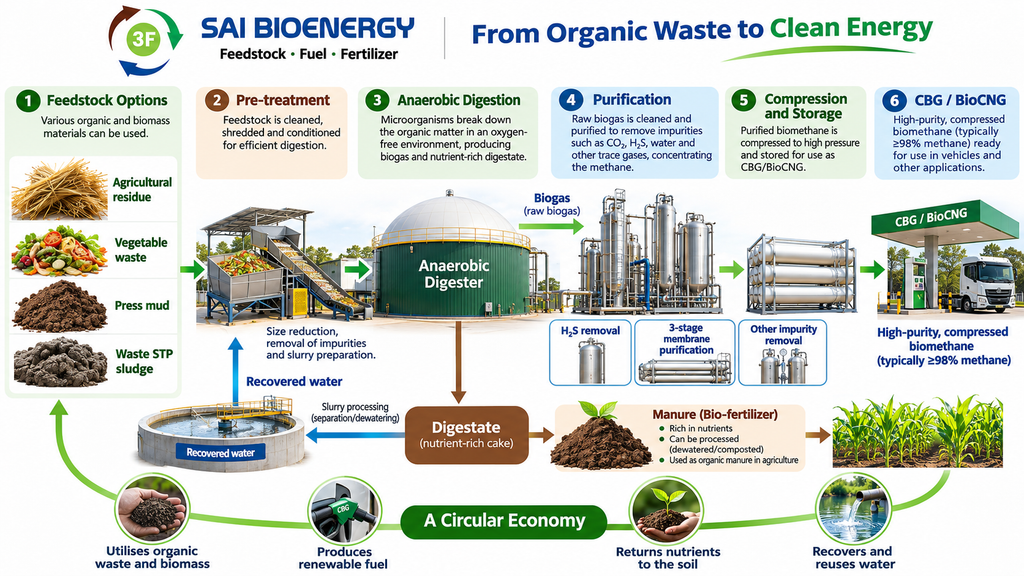
SATAT estimates show that 5,000 CBG plants can generate 50 million tonnes of bio-manure a year, effectively reducing farmer dependency on chemical fertilizers. Crops such as napier and paddy can further be reused to produce CBG thereby creating a circular economy.
From a user perspective, CBG offers the same calorific value and fuel quality as CNG but replacing CNG with BioCNG is not just an economical option for the individual. This decision directly contributes to reducing India’s import dependence on LNG, improving the country’s energy security, and contributing to our global carbon reduction goals.
Read more about Compressed Bio Gas (CBG) in our insights section.